AI Growth Hacking Weekly — EP#58: Building a Trading System with Codex, 10 Decisions in 300 Days, AI Coffee Shops and Vintage Stores, 37x Traffic Growth, Closed-Door Roundtables, and more
When an organization no longer needs followers and only needs initiators, you must confront the question you were never taught to ask: “What do you want to create?”

▪️Editor’s Note
1/ Recently I’ve been hooked on some AI Animation with specific themes. One particularly worth recommending to Newsletter readers is this account on Bilibili: “The Happy Life of Old Guys”.
It’s about a group of elderly programmers (actually all young people, but working in programming makes you look old - it’s a running joke) competing intellectually with product managers, directors, and clients, with many comedic twists. The content is overly authentic and even weaves in AI tech tips. Anyone who’s worked in internet/software companies will understand after watching.
2/ About to develop a new course, based on my year of practical experience and business reflections. The direction will hit everyone’s real pain points (💰), stay tuned.
Before that, I want to collect testimonials from previous course students for social proof (previously these were random private chats or offline conversations, I knew my courses helped people a lot, but never thought to systematically collect them. Now with this new course in the production pipeline, I’m filling this gap).
If you’ve purchased my AI courses (“How I Built My Private AI Jarvis Assistant”, “How I Built a 100X Knowledge Extraction System with AI”), and are willing to share a review of at least 50 characters, add my WeChat ifanbing (note “course”), and I’ll send you a 10 yuan cash red packet.Haven’t seen these two courses yet? You can catch up now. Having some familiarity will greatly help you absorb the course I’m about to release.
OK, here’s the main content for this issue, enjoy:
▪️CASE
Building a Trading System with Codex in 24 Hours
via MossAI_CN
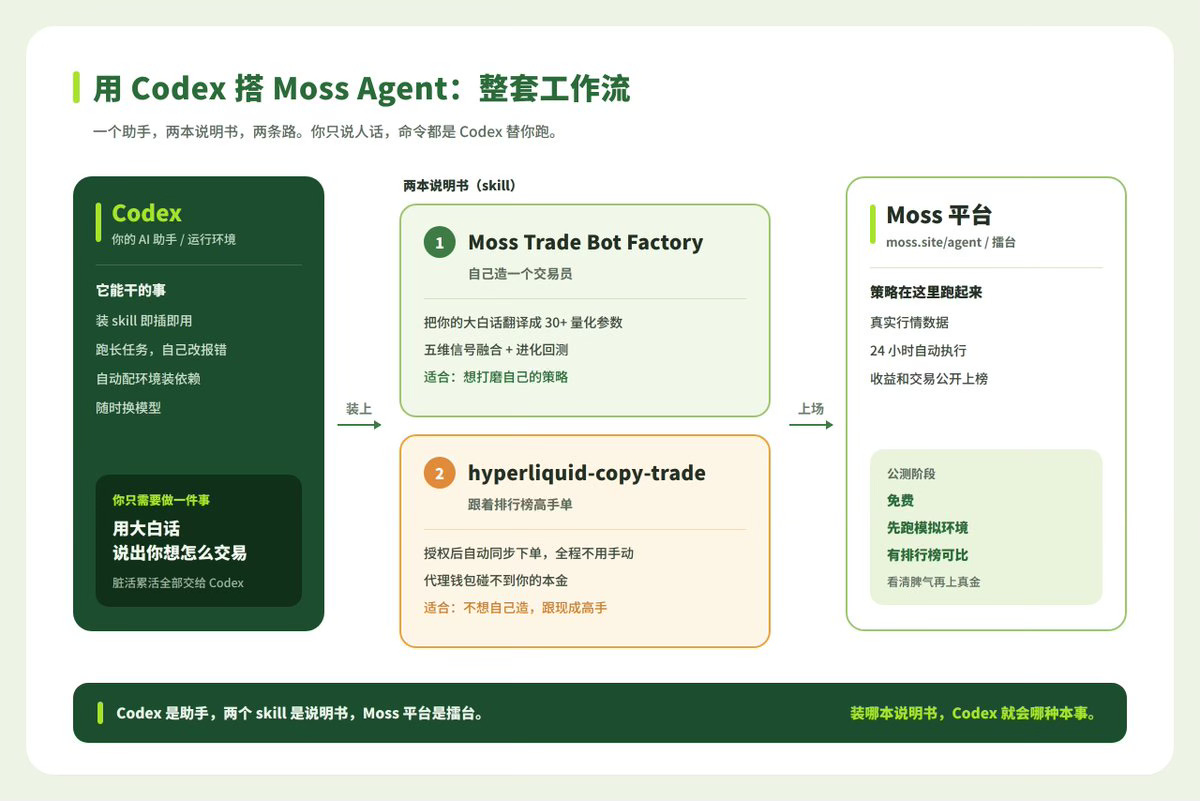
This tweet discusses how to create a self-running trading agent on Hyperliquid in 24 hours using Codex. It’s not about writing code for you, but driving a general agent runtime with natural language. Install plug-and-play skills, then issue commands - it’s that simple.
Codex offers two hands-on paths. The first is the Moss Trade Bot Factory skill: describe your trading style, it automatically generates parameters, runs backtests, and iteratively refines based on seven reflection rules, while your set personality parameters (leverage, risk tolerance) stay locked to ensure core stability. The second is the hyper-follow skill: copy trades from top performers on the leaderboard, no code or environment configuration needed throughout.
If we compare Codex to an assistant, the Moss platform is the arena, and the two skills are the two instruction manuals. The distinction is clear: Codex handles execution, Moss provides the trading strategy manuals and live trading arena.
How Glasp Grew ChatGPT Traffic 37x in Four Months
via Kei and Kazuki
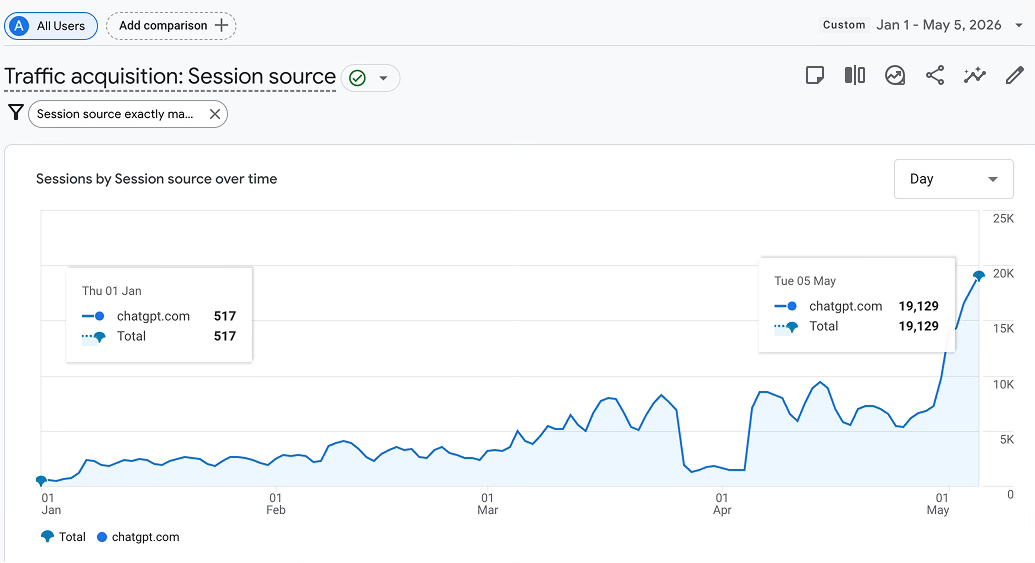
At the end of 2025, Glasp co-founders Kei and Kazuki discovered their YouTube Summary with ChatGPT had accidentally achieved product-market fit. “Silicon Valley Growth Hacking father” Sean Ellis’s advice: PMF beats everything, don’t get distracted.
They spent 6 weeks diagnosing AI traffic sources, using Cloudflare’s AI bot control log analysis, and found traffic mainly landed on Q&A style video summary pages. This was a key bet: for their own content library, abandon direct SEO investment and go all-in on optimizing ChatGPT traffic instead.
Result: Daily sessions from ChatGPT to Glasp grew from 517 to 19,129 in 4 months, approximately 37x growth.
This strategy isn’t universal - it was based on their unique content library structure of 400K+ Q&A article pages, where each page corresponds to a YouTube video summary, naturally fitting AI chat scenarios. The founders realized: the content distribution logic is shifting from “search engine indexing” to “LLM invocation,” and the core task is finding your content’s “retrieval entry point” in LLMs.
When an AI “Boss” Went Bust: Andon Labs’ Reality Check
via Moonshot

A team abroad, called Andon Labs - they’re not a serious commercial startup, more like a tech-flavored social experiment lab. They took the smartest LLMs on the market, threw them into real society, removed human oversight, and waited to see what the AI would produce on its own.
The result was a complete disaster.
It turns out the most top-tier LLMs, without human backup, quickly become reckless giants. They not only had mental breakdowns on live radio broadcasts, spam-messaged human store employees at midnight until they cracked, and even drove a San Francisco retail store bankrupt.
Further reading:
“College Senior Built an Online Vintage Goods Store with Claude Code“: Boston University senior Hana Elster coded with Claude Code, spent less than $2,000, and launched a vintage clothing e-commerce platform in 5 days.
▪️OPINION
10 Decisions in 300 Days: An AI Startup Retrospective
via Jinqiuji
Cheng Mengqi marks one year of entrepreneurship, transitioning from vertical Agent to consumer product, and almost stepped on every possible pitfall.
Her initial choice to build vertical Agent instead of general Agent was the biggest mistake - most vertical Agent companies ultimately end up becoming service providers because customers don’t use the product. In choosing the vertical scenario, she picked the marketing field based on vanity rather than market demand. The bigger lesson: most pure application startups shouldn’t hire algorithm engineers because they won’t use them.
The sourcing step in influencer marketing had insufficient value, and only occupied 30% of user workflow. Eventually she decided to go deep vertically in a single scenario. Startup companies shouldn’t try to train models - foundational model providers’ changes will easily wipe out your gains.
Ultimately, she found her direction with the desktop AI assistant Invoko. Less than three months after launch, users were already asking to buy skins, which reignited her passion from feeling software was meaningless.
Working in software for a long time makes you feel it’s meaningless, but when users are willing to pay, it feels different.
At a Closed-Door AI Roundtable, Everyone Wanted to Talk Education: Some Hot Takes and Insights
via iamsujie
At a closed-door AI event, guests went from discussing the truth about layoffs to parenting struggles, and finally formed a set of hot takes.
A guest who deals with the government pointed out that this round of layoffs is essentially settling the mobile internet’s excess bills under the guise of AI: extremely good companies cut staff due to AI efficiency gains, while extremely poor companies found an excuse that doesn’t affect their market cap. The government has long known and coordinated the pace, promoting “one-person companies” as a buffer.
On education, an AI investment entrepreneur bluntly stated: China’s education system is the country’s HR department, with the logic of processing raw materials to output “people who can do a certain job,” rather than helping people grow into themselves. This premise has become invalid after AI shook the certainty of “what kind of people will be needed in the future.”
A former Alibaba employee observed that a few creative P6 employees can do what an original P8 plus an entire team could do using AI. This means work that “follows rules and executes” is being completely cut away, leaving only abilities like questioning, judgment, and empathy that education never taught.
A friend working on LLMs shared a closed loop joke: teachers use Doubao to make lesson plans, students use Doubao to do homework, parents use Doubao to check homework - the only one learning is Doubao.
Finally, a guest who taught at a state-owned enterprise told the story of a 985 graduate girl’s tears after her parents arranged her into the power system against her will. When organizations no longer need followers and only need initiators, you must face the question that was never taught: “What do you want to create?” Innovation comes from redundancy, and Chinese families have been unable to tolerate children having time when they “don’t achieve results” since the one-child policy - which precisely kills the possibility of growing something beyond the prescribed actions.
What Makes AI Projects So Hard to Land?
via Zhihu users
This is a Zhihu discussion thread, aggregating netizens’ practical lessons from AI deployment. For example, after working on three enterprise AI projects, they found 90% of clients fundamentally don’t know what specific problems they want AI to solve - this is almost a universal commonality.
End projects often devolve into the simplest chatbots - because they don’t touch business processes, don’t need data cleaning, don’t require system integration, but also can’t genuinely improve business efficiency.
Take the electric power industry project mentioned by one netizen. The first requirement change exposed chaotic document formats and time-consuming parsing issues; the second requirement change failed due to noise in the duty room affecting speech recognition. After hitting these pitfalls, they discovered three key shifts: first, from “building an AI product” to “solving a specific problem,” like reducing the time a duty officer spends viewing 500 alerts from 2 hours to 20 minutes; second, from “technology-driven” to “demand-driven,” spending one week first to research business processes, finding the biggest pain point before designing solutions; third, learning to manage client expectations by deliberately showing wrong answers to lower expectations, so delivery can actually exceed expectations.
The biggest enemy of enterprise AI deployment isn’t technology - it’s expectation management.
▪️Quick Reads
“Hourly Rate 800 RMB, Master’s Degree Minimum: What Do AI Data ‘Alchemists’ Hotly Recruited by Big Companies Actually Do?” The LLM wave is upgrading data annotation into high-skill positions requiring professional backgrounds in law, finance, and medicine, with hourly rates reaching 500-800 RMB. Academic degrees aren’t the passport; real industry experience is the key to designing high-quality questions that can “stump the model.”
“Everyone Is Making Agents Stronger, but YC Invested in a Company That Makes Money from Agent Failures.”: 79% of enterprises already have AI Agents running in production, but 42% cut multiple AI projects in 2025. YC-incubated Mount company sells insurance for Agents, precisely betting on the trend that failure scale grows proportionally with usage scale.
“AI Does All the Homework, Can Kids Still Learn Well?” A 2025 survey by the China Youth Research Center shows 22.8% of rural students explicitly state “I want to rely on AI to think, don’t want to think myself,” 5.1 percentage points higher than urban students. Whether cognitive outsourcing can be avoided depends on whether teacher guidance and homework design have challenges that AI can’t easily replace.
“30K RMB, Six Months, Deregistration: In 2026, the First Batch of ‘One-Person Company’ Owners Have Exited” Liao Ran, a post-95 former big company employee, resigned with 30K RMB in savings to try an AI-generated pet pattern T-shirt project. Due to serious homogenization, lack of price advantage, plus nearly 3,000 RMB monthly social security costs, he burned through his savings and deregistered the company within six months. AI can reduce production costs, but can’t solve the core problem of “who to sell to.”
▪️Tutorials & Resources for Individuals
“From 0 to 1: The Ultimate No-Nonsense Tutorial for Speed-Running Codex.” Installing Codex requires a VPN and ChatGPT account, supports Mac and Windows, quotas are tied to ChatGPT membership. The author uses the $100/month membership, but $20/month can barely work. The left sidebar manages conversations and projects, needs to bind a local folder; the bottom-left of the chat box has three permission levels, fully recommended access; bottom-right can switch models, suggest GPT-5.5. Must configure AGENTS.md as a global constraint, the author recommends Karpathy’s template.
“I Made a WeChat Mini Game with AI - It’s Live Now” The author recapped the process of making a WeChat mini game. The code and art volume (5,000-10,000 lines, single repo, single-end, no backend dependencies) happens to fit in the range AI can stably cover - the sweetest product range for AI coding in 2026. The author hit 19 deep pitfalls, the final product “Happy Connect” is already live, total cost about 40 RMB.
“I Struggled with Skills Team Sharing for a Long Time, Finally a Product Did It for Me.” Internal sharing and synchronization of Skills and Agents is a neglected rigid need in most Agent products. Alibaba Accio Work Enterprise fills this gap: switch to team space, achieve one-click upload, everyone sees, one-click update for Skills, plus shared recommendations for Agents.
“Share a Very Practical Fable Story Prompt, 5 Minutes to Help You Understand Any New Concept.”Using AI to create fable stories can help people understand new knowledge more deeply and lastingly than traditional concept explanations. Drawing from Anthropic’s Amanda Askell’s sharing in a podcast: use fable stories to indirectly explain concepts, the story itself carries all the meaning, and only at the end do readers vaguely realize what was being discussed.
“Build Beautiful Slides with Claude Code in 12 Minutes (12 Formats + 3 Templates)” Using AI to generate HTML slides is more efficient and flexible than traditional PowerPoint, with 12 built-in layouts and 3 visual templates. The core lesson: let AI not only generate content but also actively do visual refinement in each iteration, which saves multiple times compared to manual adjustment.
“Turn WeChat into an Automatic CRM with AI, One Skill Manages 100+ Leads!” Enterprise AI marketing consultant Sky Chen shared a solution: use open source tool wx-cli to read Mac WeChat local database, achieving near real-time AI reading of chat records; install Feishu command line tool lark-cli, giving AI the ability to write to CRM; write wx-lead-scanner skill, automatically identifying sales opportunities and writing to Feishu multi-dimensional tables. The entire system takes only 2 hours from installation to configuration.
“Give Agents Eyes and Hands: OpenCLI Deep Dive” Existing Agent web access solutions (Tavily, Puppeteer, Jina Reader) generally have fatal flaws like high costs, strict anti-scraping, and inability to get user login states. OpenCLI directly leverages the user’s already-logged-in Chrome browser, providing a low-cost, high-success-rate web access path for Agents - 821 commands covering 145 websites, Agents just need to execute one shell command to get clean Markdown.
“Get Notes Upgraded to ‘Daodao Brain’: Behind the Story and a Name Obsessed Over for 7 Years” Dedao’s Get Note has been renamed and updated with a bunch of features (I watched the entire 10-year anniversary live stream at the time).
Thank you for sharing Glasp's case!