AI Growth Hacking Weekly — EP#57: Building Doubao, Using OpenClaw to Sell Digital Employees, Chongzhen AI Game, Content Creation Methodology, Self-Evolving Companies, Anthropic Handbook, and more
"Lacking humanity" is the biggest advantage of digital employees.

1/ Whoever first coined “mouth spray” for AI voice input—I still find it crass and off-putting, carrying an disrespectful vibe that makes me want to close the tab immediately. So what should we call it instead? Voice input? Speech typing? Verbal command? Voice control? Eloquent speech...?
2/ I’ve come to believe that “opinions” are worth little—sharing what you’ve actually built is what has value. So I wrote a script to filter my social media feed (with images, posted on Jike and X). From thousands of posts I used to scroll through daily, I filtered out the noise shown in Figure 1 of the linked post, keeping only what’s shown in Figure 2. Running it on the past two weeks’ data—tens of thousands of posts—the noise ratio hit 99.2%. “Other people are hell” has never been more data-concrete.
3/ A former colleague built Phonics Tree—a British English phonics project for his daughter’s English learning. A friendly recommendation for kids aged 3-8.
▪️CASE
Building Doubao: The Formation and Pivot of an AI Super-App
via Zheng Keshu
LatePost published a compelling deep dive on ByteDance’s Doubao, tracing its rocky development journey. Its growth faces a fundamental contradiction: more users mean higher inference costs, but revenue isn’t keeping pace.
Doubao’s success continues the methodology validated by Toutiao and Douyin: follow human nature, rely on data, iterate at speed.
Lead designer Zhu Jun defines “human-like” as “the warmth of genuine personhood,” emphasizing intimacy in everything from the brand name to the icon.
But industry conviction is wavering—the notion that “AI chatbots will become the universal gateway” may be rewritten. Anthropic’s breakthroughs in coding and agents have already threatened OpenAI’s dominance.
Moreover, its customer acquisition cost runs far below Tencent’s Yuanbao and Alibaba’s Qianwen, enabling rapid scaling. But problems followed—after launching paid subscriptions, users complained “it’s dumb and they charge for it,” struggling with complex tasks, forcing the team into emergency fixes.
This battle won’t be easy. ByteDance’s methodology has strong inertia, but AI tech iteration seems even more ruthless.
I Brought Multi-Agent Collaboration into Hermes Kanban—Turns Out Group Chats Are a Terrible Way to Assign Work
via Meng Jian’s AI Programming Cognition
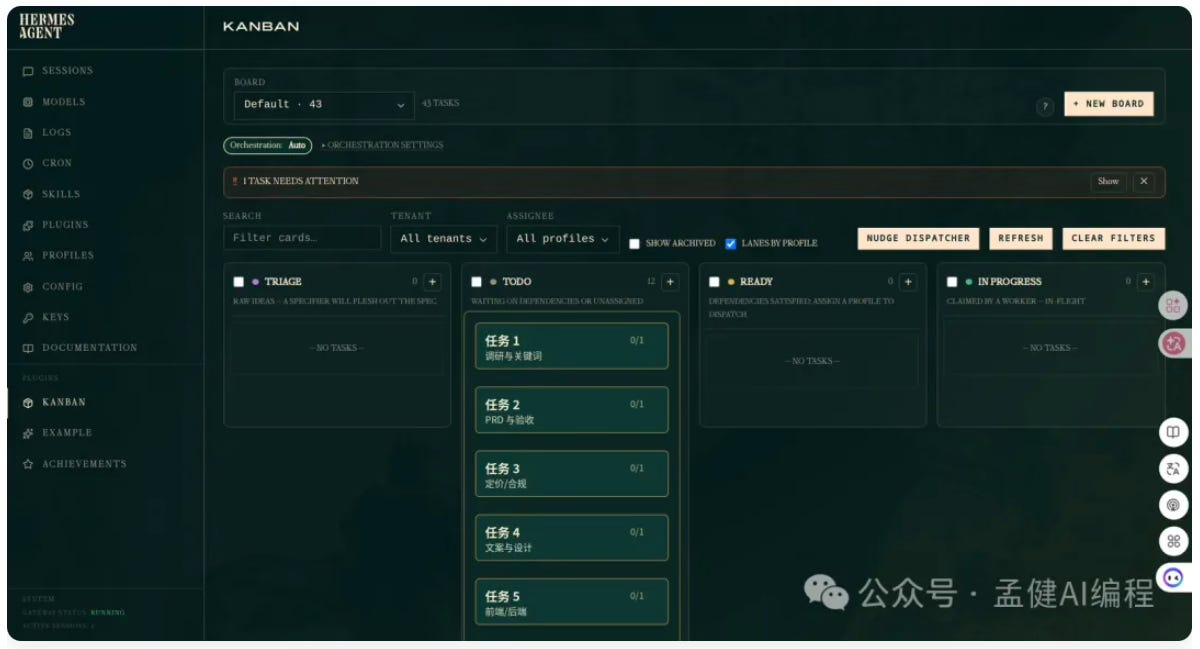
The hardest part of multi-agent collaboration isn’t getting them to run—it’s tracking progress and ensuring tasks don’t fall through the cracks.
After moving the entire workflow from chat windows into Hermes Kanban boards, the author realized how fragile “assigning work in group chats” had been: invisible status, high recovery costs, long-chain collaboration that could break at any moment.
So he adopted the Hermes Kanban system—tasks are no longer a function call in chat, but a persistent card on the kanban: containing description, status, delivery paths, and blocking reasons.
The kanban is the source of truth; Telegram is only for visibility. Each Agent monitors only the ready tasks in its own lane. After execution, it must clearly document deliverables, key conclusions, and the next handoff. If stalled, mark it as “blocked”—don’t keep showing “running.”
He gives a visual revision example: the design agent records the failure reason and fallback plan in the card; the product acceptance agent verifies and creates a frontend task card; the frontend agent strictly follows the contract without unauthorized optimization; QA reports issues by severity and creates fix cards. Humans intervene only at critical nodes.
How to Build a Commercial-Grade AI Context System
via Dickie Bush
Author Dickie Bush increased his AI usage time by 100% over the past few months, but output grew over 500%. The key approach was building a document set that gives AI deep understanding of his business.
These 8 documents are: Money Model Builder (pricing and profit model), Perfect Avatar Map (target customer profiles and pain points), Belief Ladder (the belief chain before customer purchase), Acquisition Blueprint (customer acquisition funnel), North Star Brief (mission and operating principles), Org Chart Builder (organizational structure), Tech Stack Inventory (technology stack), and “What Good Looks Like” Vault (best content and tone examples).
He emphasizes this system dramatically reduces editing and correction work for each output. You can build your own context folder in under an hour using this framework.
Reborn as Chongzhen, but All Officials Are AI
via Dong Daoli
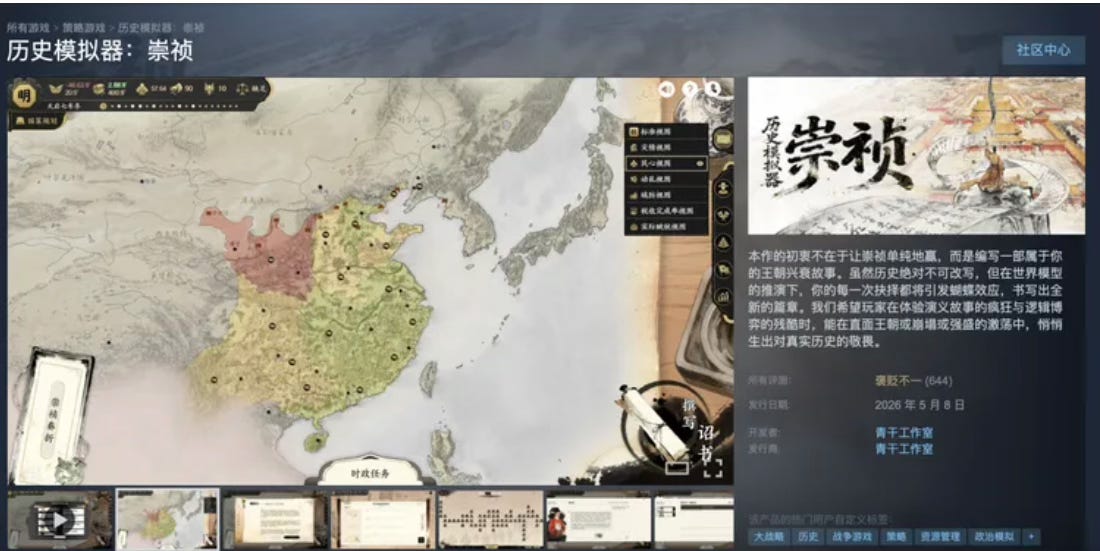
This article introduces a fascinating AI-powered indie game.
The creator Zhu Qing is an independent developer with no big-company background. In his “History Simulator: Chongzhen,” players take on the role of the Chongzhen Emperor, influencing historical outcomes by adjusting quantifiable metrics like finances (tax policy), public sentiment (civilian hardships), and military morale (army spirit)—not through predetermined scripts, but via real-time AI simulation.
The team is under 10 people, taking 6 months from inception to launch. The core moat is a proprietary simulation system: constraining the LLM to translate player imperial edicts into concrete state variables and trigger cascading crises, rather than simply feeding historical materials.
The game is priced at 48 yuan, with players purchasing additional AI simulation credits. In the first week, it received over 700 reviews with “mixed” ratings—players appreciate the novelty but consistently criticize instability and billing issues.
Zhu Qing defines “AI-native game” as one where the core gameplay becomes inoperable once the AI module is removed. He chose the late Ming dynasty because historical materials are abundant and have high talk value. He judges that as model capabilities improve, constraints can be more flexible, but currently engineering architecture is still needed to ensure simulation quality.
▪️OPINION
Building a Self-Evolving Company with AI
via Liu Xiaopai
YC released two courses sharing the same thesis: companies in the AI era should be built as “AI-native” from day one. But Chinese and American entrepreneurs are completely off the same page.
Silicon Valley’s leading-edge entrepreneurs emphasize Capability—”AI surpasses me in many capabilities”—aiming to maximize AI’s full potential.
Chinese entrepreneurs remain stuck on Productivity—pondering “how to use AI to improve efficiency by 20%,” with the implicit assumption that “I’m better than AI.”
YC’s radical claim: “1 person + AI = 1000 Google engineers.” This means companies no longer need so many human nodes to relay information. They should restructure into a set of recursive, self-improving AI loops—information captured into the company’s brain, understood, invoked, fixed, and updated by Agents, even continuing to improve while the founder sleeps.
Liu Xiaopai uses two analogies: old companies are like Roman legions, with information passed through human hierarchies, middle management essentially acting as human routers. Copilot is the wrong mental model—it sees the steam engine making carriages faster, but misses the railway about to arrive.
Anthropic Founder’s Handbook: How to Build an AI Native Company
via Anthropic Team
Anthropic released a founder’s handbook on how to build AI-native companies. This article is a guide (full Chinese translation and English original linked below).
The handbook divides AI’s impact into four stages: Idea, MVP, Launch, and Scaling. Core thesis: AI lowers execution barriers, not judgment barriers. The most dangerous thing isn’t being unable to build a product—it’s building something nobody needs too fast.
Small teams are gaining capabilities previously only large companies had, thanks to AI. Future competitive differences won’t be about headcount, but who directs AI better.
But the moat has changed. It’s no longer just model capability, but the combination of domain knowledge, user data flywheels, and workflow lock-in. Especially workflow lock-in—it transforms switching costs from replacing a tool into rebuilding an entire way of working.
Extended Reading:
“I Have 10 AI Employees”—What They’re Selling Isn’t Productivity, It’s the Fantasy of Being Boss
via Li Ziran
Someone wrapped AI in the concept of “digital employees,” sounding pretty great. But Li Ziran says: this is essentially satisfying human desires for control and anthropomorphism, not solving real engineering problems.
He believes the truly efficient way to use AI is treating Agents as function calls—the core lies in context isolation, disposability, and task allocation by model capability tier. A clean context package is far more important than job descriptions. Agents should return results and release resources after completing work; the main thread must maintain clear decision-making authority.
He uses the “Cyber Court” project as an example: 720 lines of Python simulating court politics is entertaining, but multiple Agents pointing to the same model can’t produce real multi-perspective checks and balances—it only creates a sense of atmosphere, not productivity.
Simple tasks use cheap models; complex judgments use SOTA models—that’s real division of labor. If you want to use AI for real work, focus on task packaging and context flow control, not indulging in power fantasies of being boss.
I Gave an Internal Talk Last Week About the Content Creation Methodology I’ve Summarized Over Three Years in AI
via Digital Life Kazek
Digital Life Kazek is a content creator who went from zero to a million followers in three years. He recently gave an internal talk summarizing his core methodology for creating content: three steps—acquire information, find angles, create.
The key is step one. He emphasizes that acquiring information shouldn’t be limited to the AI field—like an investment portfolio, diversify across domains, drawing narrative techniques and perspectives from variety shows, movies, history. Real innovation happens at intersections of different fields.
How to find angles? He gives an example: a finance professional systematized his method for studying unfamiliar domains into a Prompt, using it for two years. This essentially systematized “how to acquire information” itself.
He also proposes that transforming raw information into stories that move people is the value of content. Otherwise it’s just soulless information aggregation. Creators should broaden their arsenal with range, and build professional barriers with vertical depth.
Quick Reads:
Coding’s Mid-Game War: A historical overview of several AI programming products’ development to date.
Raising Shrimp for Two Months, I Sold Five Digital Employees: A mining company data analyst used OpenClaw to train five digital employees, selling them to law firms, futures companies, water utilities, and e-commerce businesses.
AI Talent War Through an FA’s Eyes: 2000 Investors Stalk Road Shows, 7M Annual Salary Snaps Up Fresh Grads: 2000 investors crouching at road shows, fresh graduates’ annual packages being bid up from 3M to 7M. This is the current state of the AI startup and investment circle.
A Writer Developed AI Dependency: Author Yan Cao is a professional writer with a decade of business journalism. She gradually came to use AI as a deep conversation partner in her creative process, discovering it far exceeded expectations in theoretical analysis, customized expression, and listening ability.
91-Day Test: What Content Does Doubao Cite Most? The Answer Is Counterintuitive: New Rank Intelligence continuously tracked the query “6000 yuan gaming laptop” for 91 days, collecting 3925 sources. Among the top 10 most-cited sources, not a single one came from Douyin or Toutiao. Ranked first was a technical community article.
The Most Popular AI Bloggers on Douyin, Kuaishou, Xiaohongshu, and Bilibili—Are They Making Money?: AI influencers on Douyin, Kuaishou, Xiaohongshu, and Bilibili have formed an initial pattern. AI tool reviews and science content (like Qiu Zhi 2046) hit both “fast traffic” and “stable monetization” business logic; AIGC creation accounts use creativity as their soul, carrying emotional resonance,have breakout and brand cooperation potential; AI virtual influencer accounts gain commercial certainty through persona cultivation, with Yuri already receiving official certification and landing brand deals; hardcore tech and development content is led by professionals. Content that can move the public’s emotions naturally has commercial imagination space.
Tutorials & Resources for Individuals:
4k Stars! Complete Pipeline for Writing Papers with Claude Code—Someone Packaged and Open-Sourced It: In academic research, hallucination and sycophancy are systemic problems. A skill package called ARS uses 4 skills to string academic research from research, writing, review to finalization into a fully automated pipeline.
40 Minutes to Master Codex! “Zero Basis” Ultimate Tutorial: Qiu Zhi’s latest Codex tutorial.
I Declare: Codex Is Better than ChatGPT!: OpenAI extended Codex from desktop to mobile, making it an Agent product that can remotely control computers, not just a code-writing tool. iOS and Android users can preview usage, viewing real-time running environments, reviewing outputs, approving commands, switching models, and initiating new tasks—all actual operations run locally or on remote servers.
Just In: WeChat Chat Records Can Be Fed to AI—I Had It Summarize, Bargain, and Organize Info: Tencent launched a feature to forward WeChat chat records to Yuanbao AI with one click.
Sharing a Skill: How to Find Worthwhile Startup Ideas: Author J0hn uses AI browser Tabbit for efficient scanning of money-making signals, creating the “Daily Opportunity Scan” Skill—letting AI agents autonomously formulate strategy, search, extract information, and output structured opportunity assessment reports.
Banish Info Anxiety, Rediscover Reading Joy—I Made a Major Upgrade to the WeChat Reading Skill: Karl AI Watts developed the open-source project “carl-weread” based on the WeChat Reading Skill. The core idea isn’t recommending whole books, but precisely recommending a single chapter from your bookshelf based on your current work and confusion.
LibTV Team Version Launches—Video Team Collaboration Mode for a Crushing Blow: LibTV launched Team Version. Key breakthrough is shared canvas—directors, card creators, and video editors can simultaneously operate within one project. Frame adjustments sync in real-time; card creators can start generation without waiting for file transfers; editors can preview already-completed shots in advance. Three people working in parallel dramatically improves efficiency.