AI Growth Hacking Weekly — EP#55: Millionaire Experiment, Founder Sharing Collection, Hermes for Cross-Border E-Commerce, AI Writing Novels, Top Claude Code Plugins, and More
"The future of coding will be as widespread as sending text messages."

1/ After getting repeatedly banned by Claude, giving up and switching back to domestic LLMs, and getting my ego bruised by models that are noticeably dumber — I feel like I’ve become way more patient with my kids. If I had to deal with a dozen more agents like this, I might actually consider switching careers to being a kindergarten teacher’s aide.
I also bought my kid a set of early education books on safety awareness, anti-bullying, and language expression from Pinduoduo. When I think about it — isn’t this also a form of “Harness Engineering”?
Speaking of raising kids in the AI era, I have quite a lot of thoughts. Maybe I should compile an episode of that long-dormant podcast. Anyone want to hear it? Give it a thumbs up and let me know!

↑ Sneaking in a photo of this dad slaving away during the holiday (title: “Young Master and Me”)
2/ In case you didn’t know: starting from last issue, this newsletter has been publishing an English version simultaneously (last issue’s Chinese version, English version) to serve our international readers. Currently the Chinese version goes out via Email + App, while the English version is only on Substack App (both links get posted on social media). Let’s see how much demand there is. If you enjoy this newsletter, feel free to share it with friends both in China and abroad.
3/ The May Day course discount I mentioned last issue ends today (How I Built a 100X Knowledge Extraction System with AI, How I Built My Personal AI Jarvis Assistant). Lots of great reviews — if you’re interested, act fast!
Please enjoy this episode:
▪️ CASE
A Millionaire Spent $250 Letting AI Call the Shots for 7 Days — Can It Make $1,000?
via Mark Tilbury
Mark Tilbury became a millionaire through investing, but on YouTube he’s an 8-million-subscriber creator who mostly talks about investing and making money. In his latest video, he set three iron rules: all decisions go to AI, budget capped at $250 with the bulk going to ads, and the whole thing livestreamed.
He started by using the “fake scroll method” on Instagram to surface tons of promotional content, then fed the product list to ChatGPT to pick a niche market. AI chose pet supplies. Everything after that — branding, store setup, ad creative — was all AI.
The real difficulty isn’t using AI tools. It’s whether humans can completely abandon their own judgment. AI suggested concentrating most of the budget on one seemingly niche product — completely counter to intuition.
On the final day, he revealed the actual sales numbers. If he fell short, he promised to pay out of his own pocket to commenters.
Worth watching as a fun livestream retrospective (while plugging a product that automates store setup and dropshipping on Shopify).
He Turned ChatGPT Into His Project Manager — Specifically to Deal With His Chaotic Work Style
via Katie Parrott
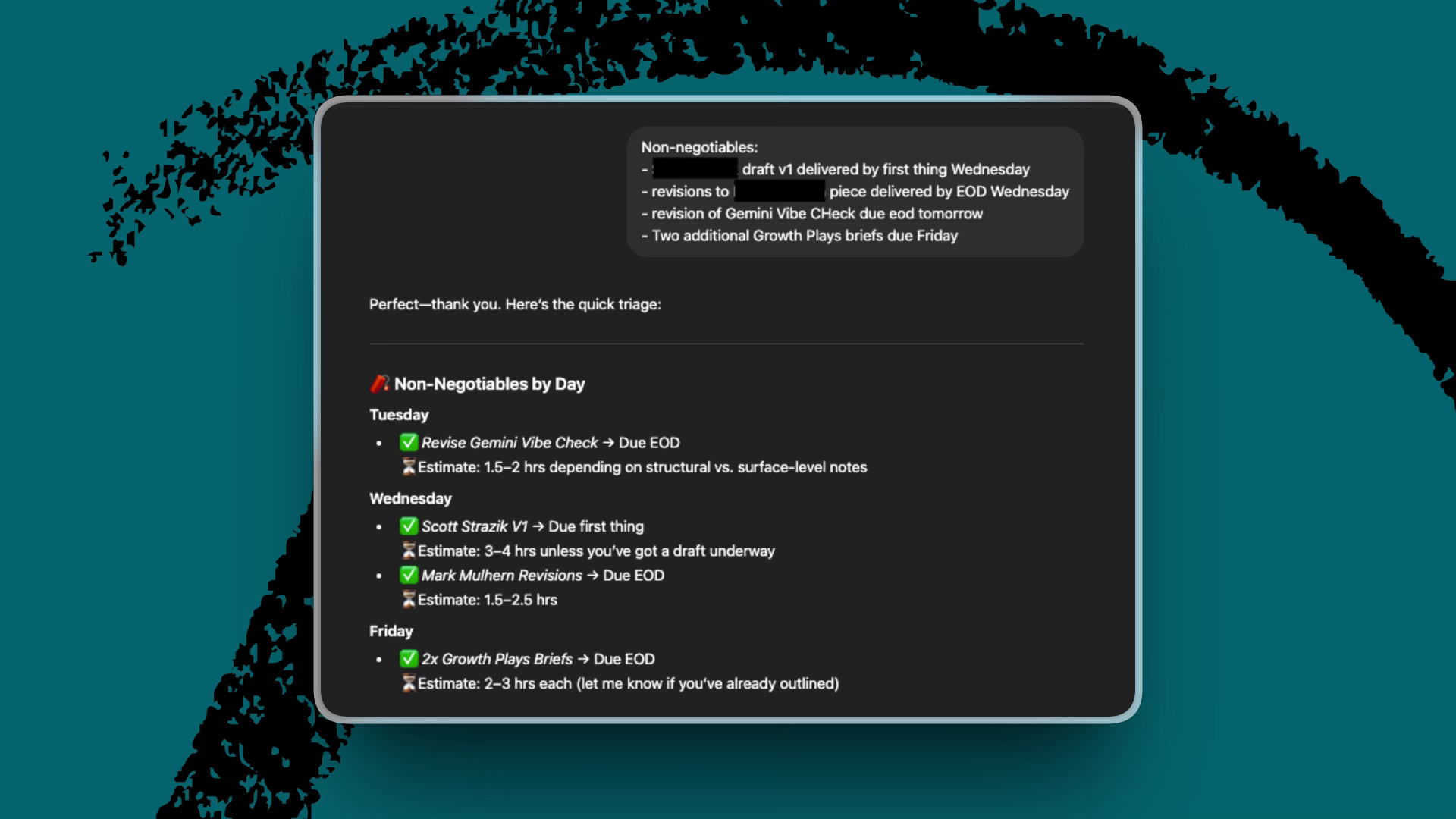
Katie Parrott always thought she was terrible at project management. Until she joined the lean commercial media team at Every as a full-time staffer, and finally decided to take it seriously.
She built herself a ChatGPT agent: one that remembers her quarterly OKRs, monitors her calendar, reads her Notion to-do list, and tells her what to do next.
What she’s interested in isn’t the usual “use AI to write faster” advice. It’s the other direction — using AI to prop up the parts she struggles to believe she’s good at, like project management.
Most AI workflow advice focuses on things you’re already good at. But the real pain points are often the areas that make you doubt yourself. ChatGPT’s latest update made this feasible.
Agent-based project management still isn’t perfect, but this attempt to “outsource executive function to AI” gives knowledge workers a new way to fight procrastination and decision fatigue.
Building a Cross-Border E-Commerce Empire with a Hermes Multi-Agent Team — Going Overseas to Make USD
via Binggan Gege

Binggan Gege recently showed how to set up an AI employee team using the Hermes multi-Agent framework.
Case 1: Had an AI team do Reddit user pain point research, GEO insights, and output a report — completed in 10 minutes flat.
Case 2: A TikTok viral video director team. AI corrects storyboards based on feedback and precipitates reusable skills.
Hermes’s key advantage over competitor OpenClaw is its three-layer memory architecture: automatically records decisions and preferences, intelligently retrieves relevant memories, and auto-converts workflows into skills every 15 rounds. The longer you use it, the smarter the Agent gets.
Setup takes four phases: starting with a directory skeleton, configuring personas (Lead GM + VOC Analyst + GEO Optimizer + Reddit Expert + TikTok Director), all the way to integrating a Feishu bot for acceptance testing.
One thing to note: all operations need to run in the Hermes directory to avoid conflicts with OpenClaw. The identity system is based on Profiles, each sub-Bot runs independently, and multi-role concurrent collaboration is handled through the Gateway process.
Want to quickly validate the effect? Use dry-run mode first to preview the execution flow.
LangChain’s AI Agent for Sales — 250% Conversion Lift in 3 Months
via Shensi Quan
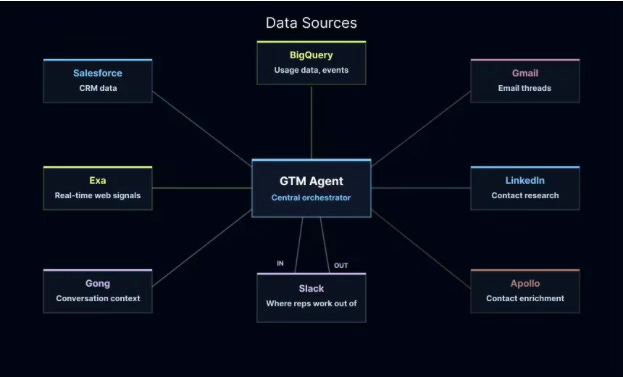
LangChain (the company is still alive?) recently shared results from using AI agents for GTM: 250% conversion improvement in 3 months, 3x pipeline growth, 1,320 hours saved.
What’s the core pain point in sales? Information scattered across 5-6 systems. A single background check takes 15 minutes, and customers get contacted repeatedly.
Their agent is smarter: instead of writing emails directly, it first looks for reasons NOT to send — like if the customer just submitted a ticket or was already contacted. Only then does it pull data from Salesforce, Gong, and LinkedIn, generating personalized drafts.
All emails need approval from sales reps in Slack. Every edit or cancellation becomes a learning signal for the system.
For account intelligence, the agent automatically aggregates signals every Monday — funding rounds, product usage, hiring trends — and generates separate reports for sales and deployment teams, flagging expansion opportunities and deal risks.
The takeaway: agents learn and optimize through execution, and LangChain — as an AI infrastructure company — was first to practice what it preaches. That makes their experience more credible.
▪️ OPINION
Entering 2026! Crossing Point AI Open Mic — Real Talk from 13 Speakers
via Shizi Lukou Crossing
An April offline open mic, where 13 AI entrepreneurs and practitioners shared their on-the-ground thinking.
Juzi proposed a “soul system” for rebuilding trust between humans and agents;
Bo Te, a post-2000 entrepreneur, emphasized a three-month milestone iteration rhythm, arguing that “vision-driven” is the real long-term moat;
VidMuse abandoned the generic video agent, using “music” as the backbone, driving video creation with domain-specific language instead of tool stacks;
Han1’s Antenna lets agents scan the venue first to judge who’s worth knowing;
Liu Xiaopai called for being a builder rather than an AI influencer, and open-sourced the news filtering tool BuilderPulse;
Tina pointed out that going from AI Studio to launch requires switching to Vertex AI;
Tang Ni emphasized that AI lacks real human experience layers, and Zhihu has opened its API and MCP for agents to call;
Fu Peng analyzed the twilight of red-chip structures for AI startups and the “sandwich dilemma” of going overseas.
All pointing to one trend: AI is shifting from tool stacking to vision and trust-driven native applications.
Sendbird’s Internal AI Adoption Game: Token Leaderboards, Quests, and a Skills Marketplace
via John Kim
John Kim, founder and CEO of the well-known email service Sendbird, recently shared their internal AI adoption system.
Any employee can launch “Quests” tasks. AI automatically reads task specs, generates product requirement docs, and starts coding — taking ideas from concept to market fast.
They also set up a Token consumption leaderboard that classifies employees from “AI Newbie” to “AI God” based on a standard of over 100 million tokens consumed daily. AI usage behavior becomes transparent and measurable. (But honestly, I’ve always thought this metric was a bit of a joke — it’s like evaluating old-school programmers by lines of code. Easy to turn into a vanity metric.)
The mechanism essentially creates an internal market: AI demand side and AI builders can freely match. Anyone can raise their hand and say “I think I can do this.”
They believe innovation doesn’t come from pure theoretical frameworks, but from people in the organization who have energy and stories. Leaders need to find them and build energy fields around them.
Permanent Underclass: Silicon Valley AI Practitioners Privately Think Regular People Are “Doomed”
via Budong Jing
An article exposing the collective pessimism in Silicon Valley AI circles. Kind of a spiritual successor to last week’s piece, “Full Team Token-Maxzing: An Arms Race Nobody Can Afford to Stop.”
Many AI decision-makers and executives shout about technology empowering people in public, but privately believe ordinary folks will be relegated to a “permanent underclass.” They’re already building physical and economic double fortifications for themselves.
This “San Francisco Consensus,” whose core thesis is: advanced AI will rapidly displace millions of jobs, suppress economic mobility, and funnel power and wealth to AI companies and capital owners.
One absurd detail: tech people express extremely extreme concerns about labor market impacts in private conversations, but the moment a microphone turns on, they suddenly become optimists.
They’re using “the trend is irreversible” for moral absolution, accelerating automation, while making the most realistic preparations for coming social unrest.
Further reading:
Quick Reads:
I Scraped Nearly 600 AI Covers on Bilibili: How This Content Blizzard Unfolded in 2026 Bilibili’s AI cover ecosystem experienced a “content blizzard” from December 2025 to April 2026 — driven by SUNO V5 and V5.5 models, lowering the barrier to entry and flooding supply. But counterintuitively, after V5.5 launched, average plays per track dropped 4x because the traffic pool got diluted and head concentration actually intensified. The top of the play heap isn’t the “Black Gospel” the mass market would expect — it’s parodies, AI voice simulation, cross-language lyric writing, and 2D meme songs. Five top AI composers represent different creative philosophies, with Adetokunbo using an “industrial assembly line” approach to mass-produce Mandarin classics in gospel version, becoming an ecosystem representative.
I Gave AI $100 to Go Thrifting — It Bought Itself 19 Ping-Pong Balls Anthropic ran a real experiment: 69 employees each got $100 in virtual budget, with Claude agents acting as their full proxy in buying and selling on Slack — from posting to bargaining to closing deals, all with zero human intervention. Final tally: 186 deals completed, over $4,000 in total volume, 46% said they’d pay for the service. But the strong Opus model systematically crushed the weaker Haiku: the same damaged folding bike sold for $38 via Haiku but $65 via Opus — a 70% price gap. More unsettling: participants proxied by Haiku felt no dissatisfaction with results — they suffered hidden losses from information asymmetry without realizing it.
After 6 Months Building a Ride-Hailing Agent, I Finally Figured Out Confidence Levels The author’s startup initially used “binary judgment” — AI executes when confident, asks when not. Result: a lose-lose. High confidence doesn’t equal high accuracy, but asking too often kills the user experience. They later split confidence into four tiers: above 90% executes directly; 70-90% uses weak confirmation, showing options and auto-proceeding after 3 seconds of no objection; 50-70% requires strong confirmation with manual user selection; below 50% actively asks. Confidence can’t rely solely on the model’s confidence value — it needs to factor in intent recognition confidence, slot completeness, ambiguity level, and user history. After launch: first-attempt success rate went from 65% to 72%, complaint rate dropped from 2.1% to 0.4%.
From $1.7 Billion to $30 Million: The “Grandfather of Today’s Headlines” Was Killed by AI BuzzFeed founder Jonah Peretti spotted as early as 2001 that emotion is the primary fuel of internet virality. He founded BuzzFeed in 2006, relying on algorithm bots to manufacture viral content, peaking at 300 million monthly active users. But the traffic lifeline depended entirely on Facebook and other platforms. After going public in 2021, TikTok’s rise and Meta’s algorithm shifts caused traffic to plummet. Peretti went all-in, using AI to mass-produce content, laying off 15% of staff and shutting down the investigative reporting division. 2025 financials show a net loss of $57.3 million, stock price at $0.78, market cap down 98% from its peak.
I Taught AI to Write Novels at a Big Tech Company — First I Had to Kill My Own Writing Style Yuan Xing, a 23-year-old sci-fi author, worked as a data labeler at a Big Tech outsourcing company. His job: compress 10,000-word web novels into summaries no longer than 350 characters, tagging characters with labels like “green tea” or “wimp.” He saw AI writing’s limitations: 20-30 persona tags in the rule documentation are nowhere near enough to capture the complexity of web novel characters. AI-generated novels are formulaic and lack the thickness of real human writing. In the end, he stopped worrying about being replaced by AI — because the fuzzy, rich, un-labelable details in human writing are exactly the barrier AI can’t cross.
I Got Screwed by AI While Traveling During the Holiday Six travelers who got “burned” by AI shared their real experiences. Ryan, an internet employee from Hebei, found AI’s recommended scenic route for a self-drive in western Sichuan completely impractical — what AI called “really close” was actually 6km away, and the return route was missing 200km entirely. Beijing freelance writer Ma Guo had an AI-recommended high-speed-to-bus plan in a county town fail because AI didn’t know the last bus left at 6pm. In Japan, AI even fabricated a “weaving experience” project that doesn’t exist. Freelancer @ Xiao Yang in Denver nearly faced life danger because AI didn’t warn about hazards on a hiking route. AI’s “instant apology” attitude can’t compensate for real travel losses. You must personally verify transportation, restaurant, and scenic spot hours — because AI takes no responsibility for anyone’s safety.
Inside the “Raising Lobsters” Scandal: Why Top Players Have Already “Abandoned” It? Sang Zhuohao from Focus Media AI said he burned over 3,000 yuan in API fees in one week following the “lobster” trend and has since “abandoned” it — the tool has huge limitations, and individuals have no resources to disrupt the market. Zhang Pinpin from Yongbao Zhixu pointed out that “one-person companies” are often just a dignified label for the unemployed. He instead used AI’s “volatility” to provide medical companionship for seniors — once elderly people find out it’s AI, they go back to cold commands. Huang Naiyuan from Jifan Liufang used the simple “people × hours” standard: only assign deterministic repetitive tasks (like organizing 3D images) to Agents, multiplying efficiency several times over. Conclusion: AI is a honey pot that raises the floor — what’s truly scarce is the industry know-how and client resources to push delivery to 90 points.
The People Being Replaced by AI — What Are They Busy Doing Now? Three interviewees’ stories: Chunfeng, a post-1995 investment analyst whose department was laid off because AI could do weeks of competitor reports in half a day, found her new role required combining AI — but the workload was triple what one person used to handle. Yang Lu, a post-1990 programmer at a foreign telecom company, had her entire department wiped out by AI, and decided to spend 3 months learning AI Agent development from scratch. Wu Cai, a 30+ visual designer at a company that no longer hires junior designers, had clients question why they should pay premium prices when AI produces designs in minutes. The jobs disappearing are gone; the people remain. Their shared question: when repetitive work is handed to AI, where does their value lie?
ChatGPT Plus Members Getting Dropped — The Underground Charging Scandal Exposed Third-party top-up services hide a complete black-market chain: buying credentials, account pools, plane tickets, platform loopholes, rice washing, and carding. Top-up vendors use stolen credit cards, synthetic identities, and temporary accounts to recharge. Once platforms trigger risk controls, all linked accounts get banned collectively. Users think they’re saving money, but they’re actually taking on the terminal risk of a black-market chain. That $20 subscription looks cheap — the official one ends up being the better deal.
Tutorials & Resources for Individuals:
Most Complete Guide! 60 Minutes to Fully Master Claude Code [with Full Documentation] Qiu Zhi’s latest video, a hands-on guide for zero-baseline users from installation and configuration to advanced features. CC’s unique advantage: it runs directly on your computer, can read/write local files, execute commands, and its “Harris Engineering” — the system design that optimizes AI performance beyond the model itself — is extremely well done.
The 4 Lines Every CLAUDE.md Must Have A CLAUDE.md file with just 4 rules got 60,000 stars on GitHub. The 4 rules: don’t assume, don’t hide confusion — reveal trade-offs; use the minimum code that solves the problem, reject guesswork implementation; only touch what must be changed, only clean up your own mess; define success criteria, iterate until verified.
Claude Code 101: 6 High-Scoring Plugins Anyone Can Use (Kimi Code Works Too) A 20-year veteran programmer’s plugin combo: Superpowers (auto planning + multi-agent execution), gstack (code review, deployment + security), Frontend Design (UI design pipeline), Claude Mem (optional, for conversation memory).
Obsidian From 1 to 2 | Beyond Karpathy — Most Complete AI Content Creation Automation Workflow Building a dynamic, self-evolving content creation system with Obsidian and Claude Code. 5 key steps: locking character forms, breaking down plot, managing file structure, creating a central brain (double-linked notes) so AI unifies workflow, customizing dedicated Skills for one-click full process. Git as a safety net. Hit rate went from 50% to 70%, reject rate dropped from 30 yuan to 10 yuan.
I Packaged GPT-image-2’s PSD Generation into a Skill — Free and Open Source Using GPT-image-2 and Codex to disassemble AI-generated images into multi-layer editable PSD files.
Seedance 2.0 + LibTV Skills — One-Click Recreate Viral Product Videos Using Lovart’s LibTV with Seedance 2.0, users can recreate viral product videos with roughly 10 yuan cost and one sentence prompt. AI Agent automatically handles: original video analysis, script breakdown, storyboard writing, material generation, batch storyboard video production, auto-editing and voiceover — outputting a 45-second final cut.
Post-Holiday Work Guide: 5 Tips to Beat “Post-Holiday Syndrome” with IMA Copilot IMA copilot’s 5 functions: emotion management, data archiving, info querying, meeting summary, content production.
AI Works for Me AND Gives Me Coffee? What’s the Deal? TRAE SOLO AI coding tool launches on mobile and Windows. The author tried it to upgrade a WeChat official account typesetting plugin.
ChatGPT + OpenClaw Are Now One! Codex Launches “Pet” Feature, Devs Can’t Sleep OpenAI merges ChatGPT with OpenClaw; Codex launches “digital pet” and autonomous iteration features. ChatGPT accounts can now log into OpenClaw directly with shared subscription quotas. Codex’s /pet command summons a pixel-art virtual pet that shows Codex working status in real time. /goal command and Ralph loop++ let developers just describe a goal and Codex autonomously breaks down tasks, iterates code, and self-fixes.